
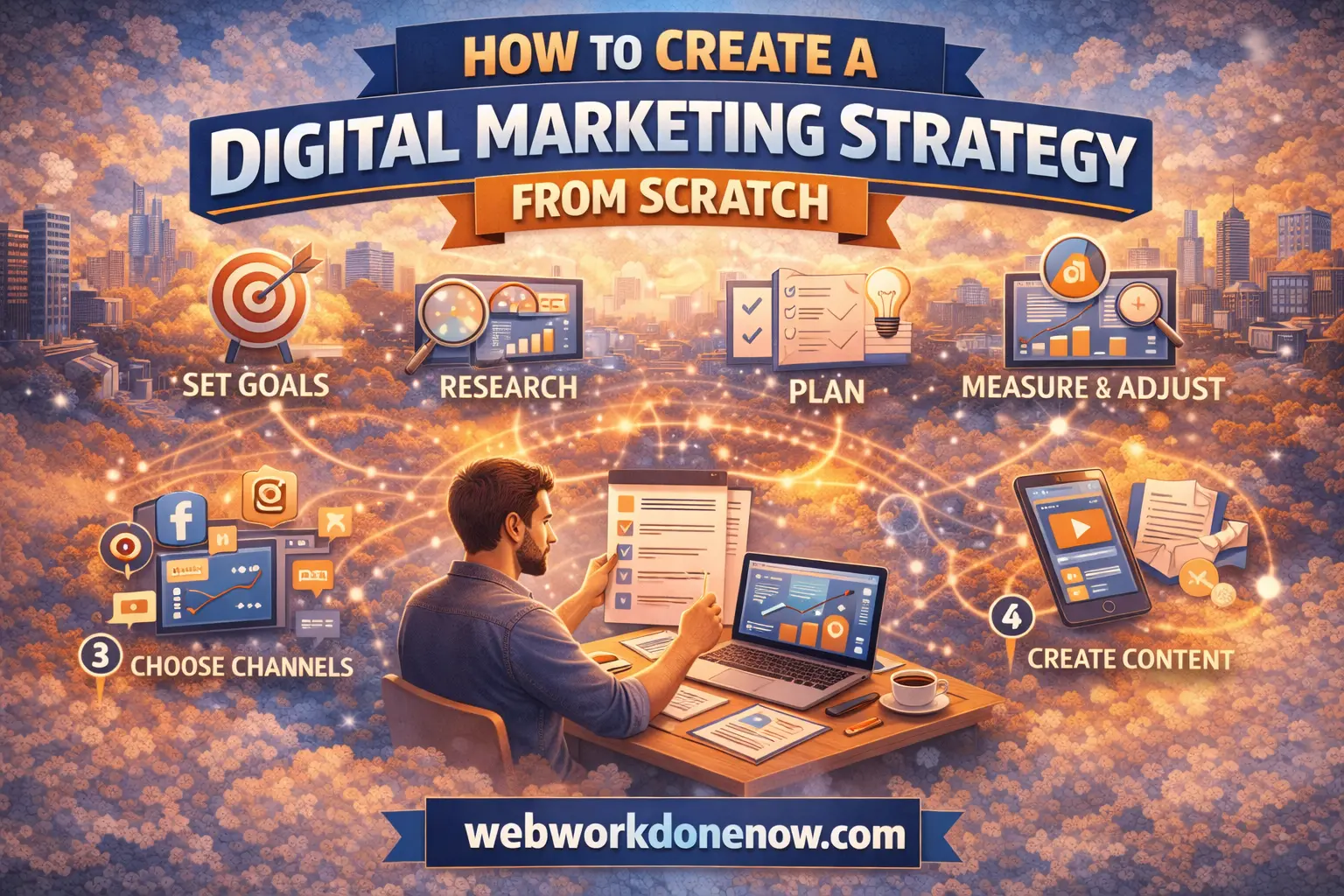
“I burned $3k on ads before realizing I didn’t even have tracking set up.”
This isn’t just one person’s mistake. It’s a pattern. Solo founders and small teams keep hitting the same wall: they jump into execution without a plan. Then they’re stuck with scattered efforts, random wins and tight budgets that stretch too thin.
You don’t need more tactics. You need order. One strategy. Built for AI-driven platforms, built for small budgets, built to give back control.
This guide is based on an agile framework tailored for solo operators and small teams. It aligns to revenue, not vanity metrics. Built to adapt fast. Built for 2026 and beyond.
Set SMART Goals and KPIs
Without clarity, everything feels random. Strategy starts with defining what success means. Not just traffic, but outcomes. OKRs like “Acquire 500 MQLs via GEO by Q2” create a north star for every future decision. By setting specific and measurable goals you save yourself from wasted effort. They prevent rabbit holes like running TikTok ads without knowing why. That’s not guesswork. That’s a system that strengthens your digital marketing services and keeps every move aligned with real objectives.
Setting SMART goals also gives you real benchmarks to track. Use Google Looker Studio or GA4 to monitor metrics like CAC under $50 and 15% monthly engagement growth. Align each metric with a stage in your funnel. If the business is B2B, make LinkedIn a core touchpoint. 45% of leads convert there as many founders and decision makers hang out on that platform.
Agility matters. Set quarterly sprints: Q1 for audit, Q2 for launch, Q3 for iteration. This rhythm gives breathing room for improvement without the pressure of one giant yearly goal. It also matches how real users evolve across the year.
Research Audience and Competitors
When you don’t know your audience deeply, every post feels like a shot in the dark. Demographics used to be enough. Not anymore. Platforms like Reddit and Hotjar show what users feel and not just who they are. Build 3–5 personas based on behavior, fears and triggers. For example, many solopreneurs today say they’re “paralyzed by AI changes.” That fear shapes content tone, channels and pacing.
Your competitors are dropping the ball here. Most use generic templates and skip psychographics entirely. That opens a clear lane. Use SEMrush or Ahrefs to uncover keywords they’re missing, terms like “digital marketing plan template free” have lower competition but strong intent. Frame your content around those.
Mapping the journey is your edge. Serve GEO-optimized articles in awareness. Move to webinars for consideration. Use ROI-based case studies for decision stages. This flow mimics natural buying behavior.
With cookies fading out, collect first-party data through quizzes or gated resources. This boosts personalization without sacrificing privacy and it builds long-term trust.
Select Channels and Content Pillars
Posting on multiple marketing channels is a bad strategy. Instead prioritize 3–5 channels using the 70/20/10 rule. That means putting 70% effort into owned content like SEO and blogging. 20% in paid ads. And 10% in earned PR or mentions. This forces intentional focus. And focus makes measurement real.
GEO and conversational SEO matter most in 2026. Searchers now ask questions like they talk. Optimize for phrases like “best digital marketing strategy 2026” using structured data and schema markup. That’s what makes you show up in AI-generated snippets.
Use TikTok for Gen Z offers and Instagram Reels for B2C. For B2B go deep on LinkedIn and email nurturing. Klaviyo flows when paired with automation via n8n now drives 42x ROI when executed with solid segmentation.
Organize content around 3 core pillars. Education (how-tos, explainers), Entertainment (relatable founder pain stories) and Promotion (offers, case studies). This mix holds reader attention over 3 minutes per visit boosting dwell time and ranking.
Organize content around 3 core pillars: Education (how-tos, explainers), Entertainment (relatable founder pain stories) and Promotion (offers, case studies). This mix holds reader attention over 3 minutes per visit boosting dwell time and ranking.
Build Your Content Calendar and Budget
Your competitors publish reactively. That’s where they lose. A structured content calendar solves that. Plan a weekly cadence: two SEO-driven blogs, five social posts, one email. Anchor them to your topic clusters like “how to build a digital marketing strategy.” This structure reduces context-switching and accelerates delivery.
Use tools like Airtable or Notion to create your content calendar. For faster execution you can even prompt Claude or Gemini Studio to draft outlines and articles based on your briefs. Then human-edit for tone, trust and nuance. You cut planning time in half while keeping quality tight.
Budget realistically. If under $100K/year, go 40% to content creation and AI tools, 30% to ads, 20% to analytics and 10% to A/B testing. That setup lets you scale or trim as results dictate.
Repurpose content smartly. One blog becomes a YouTube short. And a LinkedIn carousel. This single-source approach gets 4x reach without 4x work.
Implement, Measure and Iterate
The perfect plan means nothing if it stays static. Execution matters much more than theory. Launch a minimum viable plan by week four. Track every asset with UTM links and GA4 so you don’t have to wait for perfect setup. What matters is motion, and that’s exactly the mindset we follow at Web Work Done Now to keep every project moving forward.
A/B test every email subject line, blog headline and CTA. You’ll often find a 20–30% uplift just by changing the first seven words. Keep a list of what wins. Kill what drags.
Review your dashboard monthly. Metrics like ROAS above 4x churn under 10% and 15% growth tell you what’s moving the needle. They also highlight weak points early. This gives you extra time to adjust.
The fastest growth comes from doubling down. Reinvest 20% of returns into channels that prove their value, usually SEO or nurture email. Each quarter, run a fresh audit to align with new algorithms or audience behavior shifts.
Adaptation is the advantage. Especially when everyone else is guessing.